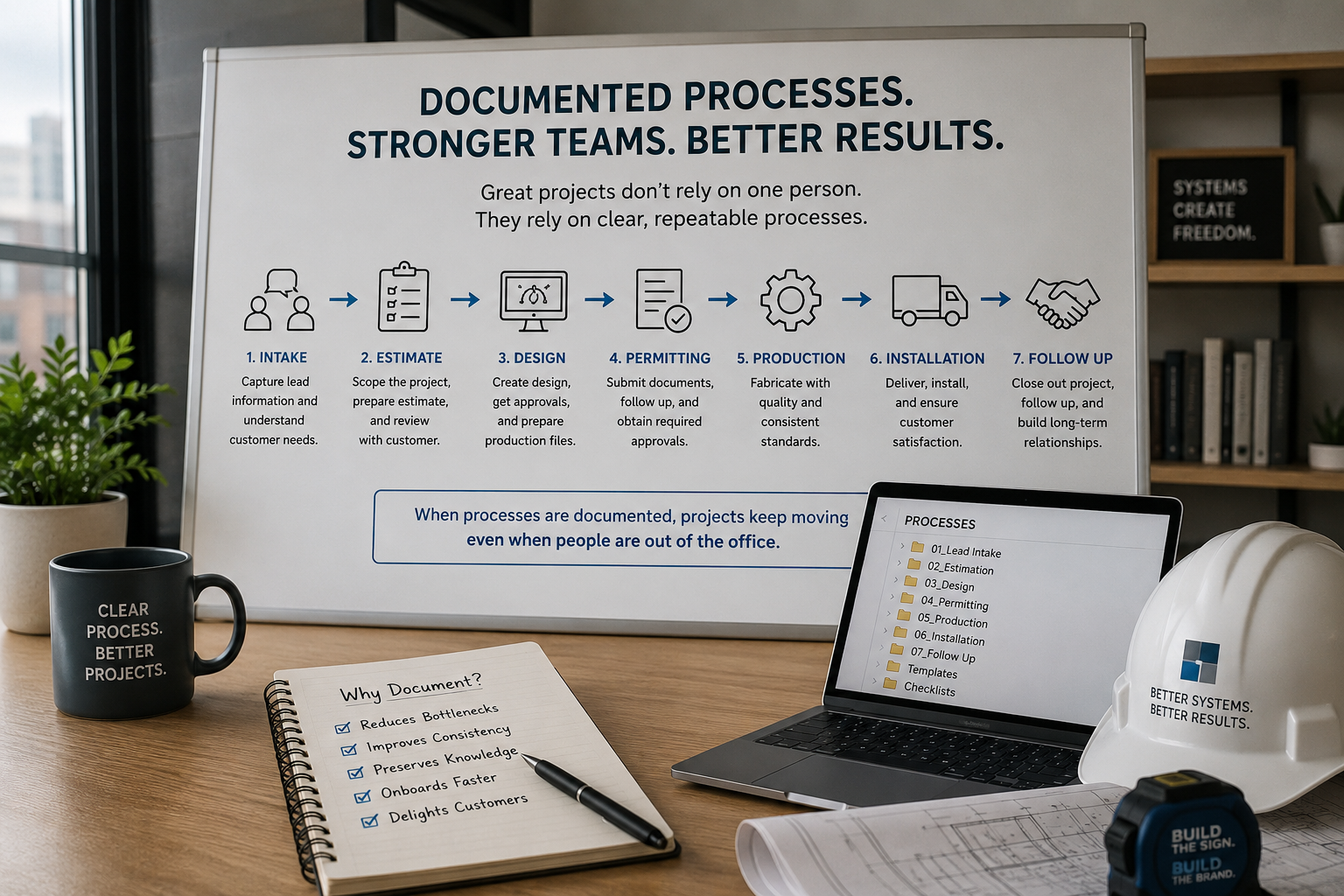
Why Documented Processes Matter More Than Ever
When most people hear the words “process documentation,” they immediately think about automation, AI, or replacing employees.
I think that’s the wrong conversation.
The real purpose of documentation isn’t to replace people. It’s to reduce bottlenecks, improve consistency, and ensure projects continue moving forward when key team members are unavailable.
Every business depends on people with specialized knowledge. In the sign industry, that knowledge may include sales, site surveys, design, permitting, project management, fabrication, scheduling, installation, or customer communication.
The problem arises when critical information exists only in someone’s head.
The Hidden Cost of Tribal Knowledge
Imagine a company where only one person knows how to submit permits.
What happens when that person takes a vacation?
What happens if they’re out sick?
What happens if they’re unavailable when a customer needs an answer?
The same question applies to production, scheduling, estimating, installation, accounting, and customer service.
When knowledge is not documented, projects slow down. Decisions get delayed. Customers wait longer. Team members spend valuable time tracking down information that should already be accessible.
This isn’t a people problem.
It’s a systems problem.
Documentation Doesn’t Replace Expertise
One of the biggest misconceptions about documenting processes is that it somehow reduces the value of the people performing the work.
In reality, the opposite is true.
The most valuable employees are often the ones who can clearly explain what they do and why they do it.
A documented process doesn’t eliminate expertise. It captures it.
It allows experienced professionals to share years of knowledge in a way that helps others learn, improves consistency, and reduces unnecessary mistakes.
A checklist cannot replace experience.
A procedure cannot replace judgment.
A template cannot replace expertise.
But all three can help a team perform at a higher level.
Better Systems Create Better Customer Experiences
Customers rarely see the internal workings of a business.
They don’t see project handoffs.
They don’t see scheduling meetings.
They don’t see production workflows.
What they do notice are missed deadlines, inconsistent communication, and delays.
Well-documented systems reduce those issues by creating clarity around how work gets completed.
When everyone understands the process, projects move more efficiently. Questions get answered faster. Team members can step in and assist one another when needed.
The result is a smoother experience for both employees and customers.
The Goal Isn’t Automation
The goal isn’t to replace people.
The goal is to make sure the business can continue serving customers when someone takes a well-earned vacation.
The goal is to reduce single points of failure.
The goal is to create consistency.
The goal is to preserve knowledge instead of losing it.
Every organization has key people whose experience and expertise are invaluable. The strongest organizations are the ones that find ways to capture that knowledge, share it, and build systems around it.
Final Thoughts
Whether you’re running a sign company, a design studio, a construction firm, or any other service-based business, documentation is not about removing the human element.
It’s about supporting it.
The businesses that thrive over the long term are not the ones that depend entirely on individual heroes. They’re the ones that build systems that allow talented people to do their best work consistently.
Because at the end of the day, success isn’t measured by how much information one person can hold in their head.
It’s measured by how well an organization can deliver results, even when that person isn’t in the room.