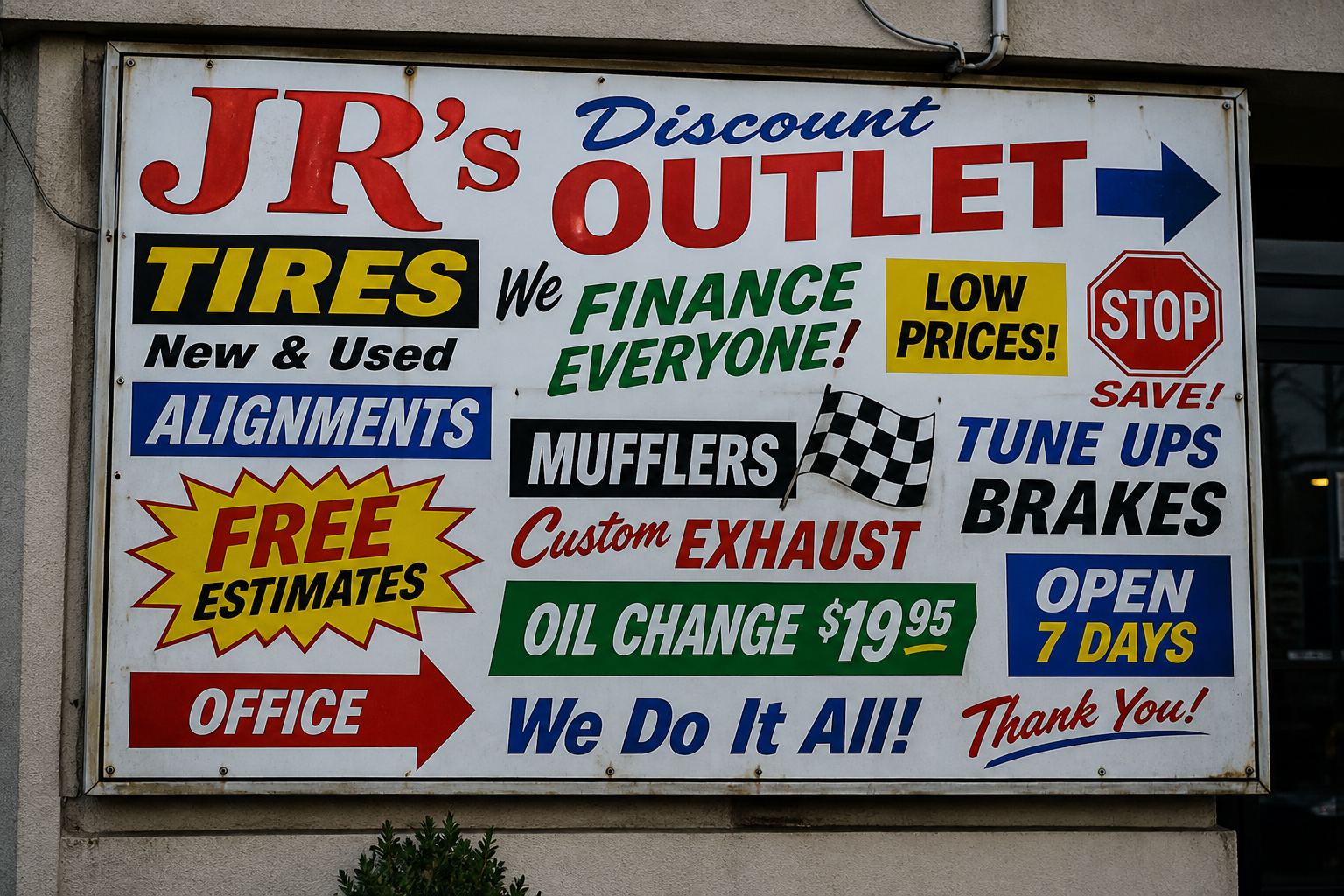
“Nothing Fuels the Sign Industry Like Confident People With No Understanding of Design”
There is a strange contradiction in graphic design.
Everyone notices bad design instantly.
But very few people understand what good design is actually doing.
A sign feels “cheap.”
A logo feels “off.”
A lobby feels confusing.
A menu feels stressful.
A storefront feels forgettable.
People feel the result long before they understand the reason.
That is because design principles are not random art-school opinions. They are patterns tied directly to human psychology. Hierarchy, contrast, spacing, rhythm, proportion, repetition, alignment, color relationships, readability, scale. These are systems of visual order that help the human brain process information faster and with less friction.
Good design reduces mental effort.
Bad design increases it.
Most people think designers “make things look nice.” In reality, designers organize information, guide attention, reduce confusion, create trust, and shape perception before a single word is spoken.
Especially in signage.
A sign has to survive distance, speed, lighting conditions, fabrication limitations, viewing angles, materials, weather, code requirements, installation realities, and human attention spans measured in seconds. That is not decoration. That is applied problem solving.
The irony is that the better a designer is, the more invisible the work becomes.
When hierarchy works, people do not notice hierarchy.
When spacing works, people do not notice spacing.
When navigation works, people do not notice wayfinding.
They just move through the space naturally.
That invisibility is part of why graphic designers are chronically undervalued. The work appears effortless after years of experience compress complexity into instinct.
And designers themselves often contribute to the problem.
Many designers accidentally position themselves as software operators instead of decision makers. They charge for time instead of judgment. They talk about tools instead of outcomes. They accept endless revisions without boundaries. They apologize for pricing while other industries invoice confidently for expertise that affects far less.
Meanwhile, businesses are making real money from perception.
The right environment increases trust.
The right signage improves navigation.
The right branding increases recognition.
The right presentation changes customer behavior.
Design has measurable business impact, but many designers still price themselves like production labor.
Part of this comes from the culture around creative work. People grow up hearing phrases like “I could make that in Canva” or “my nephew does logos.” The software became accessible, so people assumed the expertise became accessible too.
It did not.
Owning a wrench does not make someone a mechanic.
Owning a camera does not make someone a cinematographer.
And opening Illustrator does not make someone a designer.
Especially inside sign shops, designers often become hybrids without realizing their market value. They are handling layout, production files, client communication, fabrication prep, permit coordination, material selection, install considerations, and troubleshooting problems before production even begins.
That knowledge compounds.
A designer who understands fabrication is dramatically more valuable than someone making isolated visuals disconnected from reality.
Which raises another question:
Why are so many sign shop designers underpaid?
Because many shops still treat design as support labor instead of revenue generation.
But smart designers can change that by making themselves financially harder to replace.
One of the best ways to increase income in the sign industry is building parallel value streams around the core skill set.
That can include:
* Freelance branding packages
* Vector recreation services
* Wayfinding consulting
* Permit drawing packages
* Fabrication-ready artwork cleanup
* Vehicle wrap layouts
* Window graphic packages
* Interior branding systems
* Sign surveys and documentation
* Google Business profile visuals
* Brand standards guides
* Environmental graphics consulting
* Local business partnerships with architects and interior designers
* Print brokerage markups
* Installation coordination
* Creative direction retainers
A designer inside a sign shop already sees problems most businesses do not even realize they have.
That knowledge is valuable.
The shift happens when designers stop viewing themselves as “the art department” and start recognizing themselves as visual communication specialists operating between branding, psychology, production, and the built environment.
Because that is what the job actually is.
And the companies that understand this first are the ones that stop treating design like an expense and start treating it like infrastructure.
Closing Thought
Most people only notice design when something feels wrong.
The sign is hard to read.
The space feels confusing.
The branding feels inconsistent.
The install does not match the rendering.
The permit gets delayed.
Production hits avoidable problems.
That is usually not a software problem. It is a planning problem.
Good designers are not just arranging graphics. They are solving communication problems before they become expensive real-world problems.
Especially in signage and environmental graphics, the work lives far beyond the screen. It has to survive fabrication, permitting, installation, scale, lighting, materials, and human behavior in real environments.
That level of thinking is what separates decoration from design.
If your business, sign shop, architect, or interior team needs support with vector artwork recreation, fabrication-ready files, or permitting and construction documents, visit Andysheh Design at andyshehdesign.com.
Clear files. Buildable drawings. Real-world design support.
#Cincinnati #NKY #NorthernKentucky #CincinnatiDesign #CincinnatiBusiness #EnvironmentalGraphics #SignageDesign #Wayfinding #GraphicDesign #Branding #InteriorDesign #Architecture #ExperientialDesign #SmallBusiness #CreativeIndustry #Fabrication #SignIndustry #CincinnatiOhio #NKYBusiness #AndyshehDesign