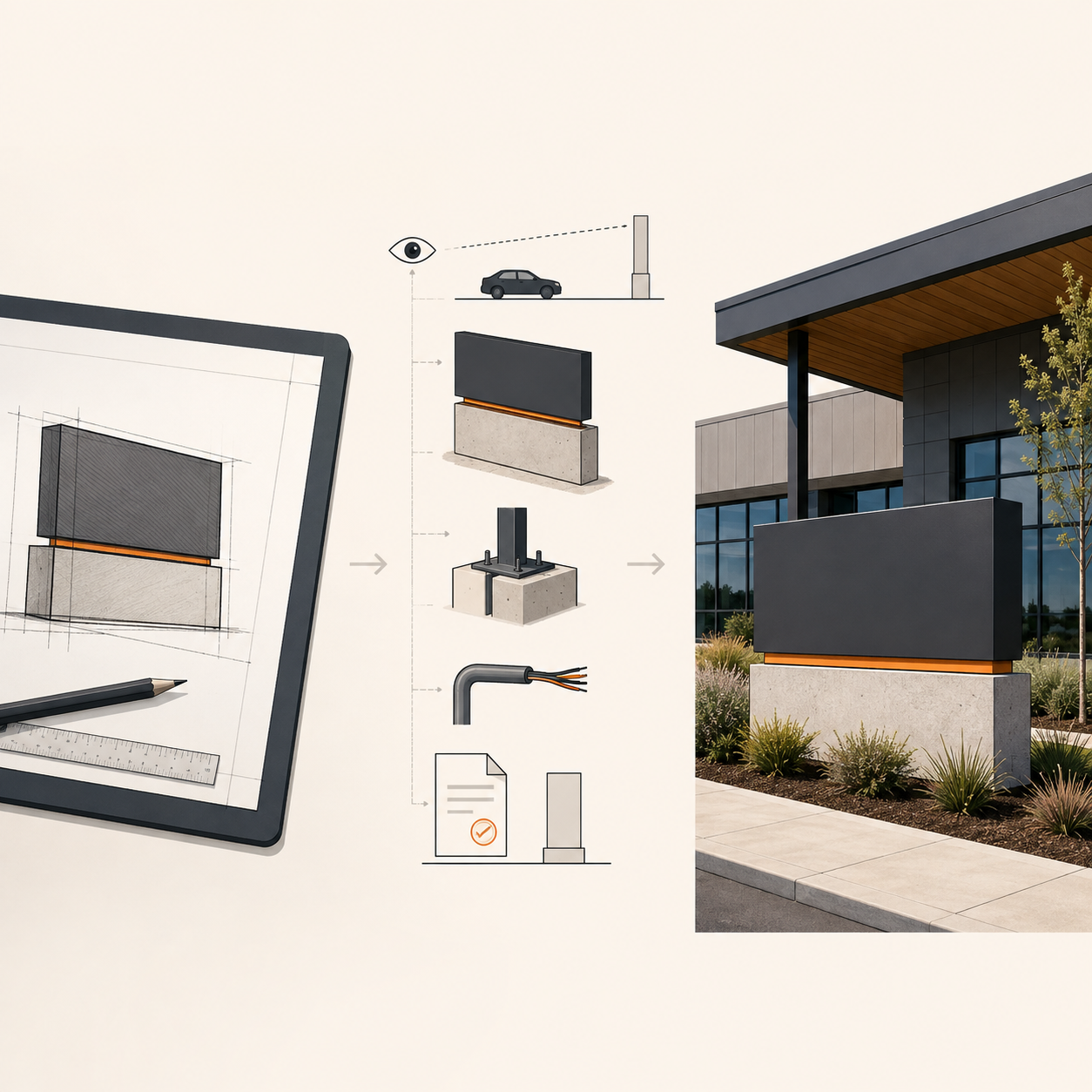
Most Sign Problems Begin Long Before Fabrication
Sign projects rarely fail because someone cannot build the sign. They fail because important questions were never answered early enough.
Will it be readable from the road? Does the artwork contain details that can actually be fabricated? Does the sign complement the architecture, or does it look pasted onto the building? Can the electrical components be accessed later? Will it meet local code? Does the proposed mounting method work with the wall construction? These are design questions, but they are also production, permitting and installation questions.
One of the most common problems is designing at the wrong scale. A logo may look perfectly clear on a screen but become unreadable from 200 feet away. Thin strokes disappear. Small secondary copy becomes clutter. Subtle color differences lose contrast. The solution is not always making everything larger. It is establishing a clear visual hierarchy based on viewing distance, speed and surroundings.
Artwork is another frequent issue. A file can be technically “vector” and still be unusable for production. Automatic tracing may create thousands of unnecessary shapes, uneven edges and details that cannot be routed, cut or illuminated. Clean production artwork must account for minimum stroke widths, material thicknesses, fastening methods and how the finished sign will actually be assembled.
Coordination creates its own set of problems. Designers, clients, fabricators, installers and permitting departments often evaluate the same sign from completely different perspectives. If those perspectives are not connected early, the project can accumulate revisions, delays and unexpected costs. A strong design process considers code, structure, access, fabrication and installation before the concept is presented as finished.
Budget reductions also need more thought than simply shrinking the sign or selecting cheaper materials. Good value engineering protects the parts that make the sign effective while simplifying the parts that add cost without adding much value. That may mean reducing illumination, standardizing components, adjusting the structure or changing materials without compromising visibility or longevity.
The best signage solutions come from identifying these conflicts before they reach production. A successful sign should strengthen the brand, fit the environment, meet code, stay within budget and be practical to manufacture, install and maintain. When all of those considerations work together, the result does more than look good in a rendering. It works in the real world.